How to Verify an AI-Generated Data Answer
A query, citation, or confident explanation is not the proof. Verify the business definition, counted population, representative records, freshness, resulting state, and reviewer.
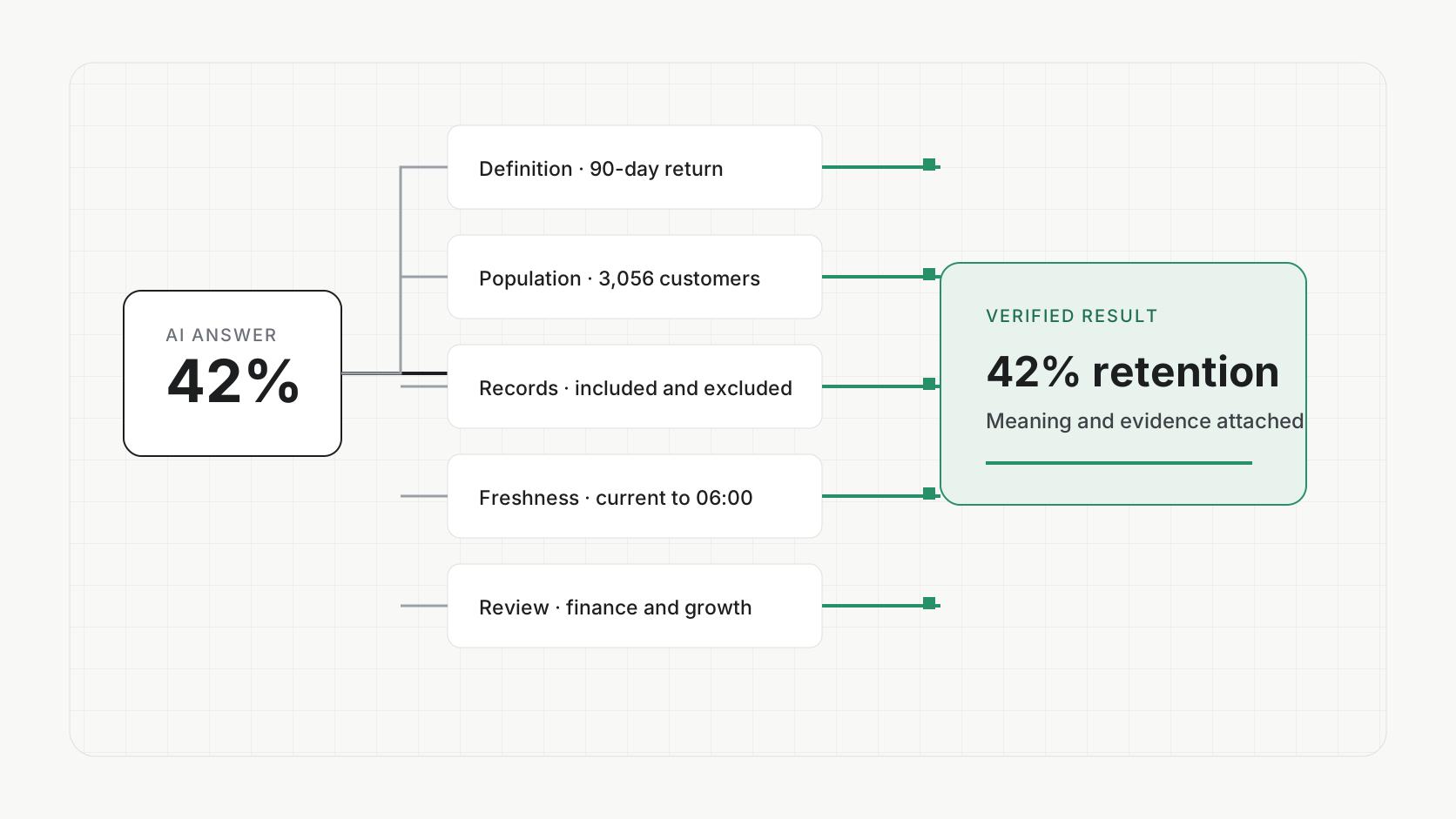
When an AI tells you retention is 42 percent, the first question is not, “Did it show me the SQL?” The first question is, “Can I explain exactly what this number means, who it counted, how current it is, and what would make it wrong?”
SQL matters. Citations matter. Tests and lineage matter. But a business leader should not need to audit a generated query to decide whether a number belongs in a leadership meeting.
The answer needs a human-readable evidence path.
The failureA good transcript can still produce the wrong outcome
An AI can describe a careful method, write valid SQL, run the query successfully, and still answer the wrong business question. It can choose the wrong population, use an old definition, join at the wrong grain, miss a late-arriving source, or return a number that never reaches the dashboard the user actually sees.
This distinction appears directly in Anthropic's guide to evaluating AI agents. The transcript is the record of what the agent said and did. The outcome is the final state in the environment. An agent can say a flight was booked; the outcome is whether the reservation exists.
For data work, the same rule applies. The agent can say the metric was updated. The outcome is whether the approved definition, query result, processing run, dashboard, and downstream use now agree.
Transcript evidence
The prompt, reasoning, tool calls, SQL, citations, and the agent's final explanation.
Outcome evidence
The resulting records, report state, freshness, customer examples, tests, review, and downstream effect.
Start with the decision, not the query
Before verifying the number, name what someone is going to do with it.
A rough directional answer used for exploration needs less proof than a number going into a board deck, a customer commitment, a financial plan, or an operational workflow. Consequence determines the verification bar.
Write the acceptance condition in plain language. For example:
We need the share of customers who placed another order within 90 days of their first order, using orders processed through yesterday at 6:00 a.m. Eastern. Finance and growth should be able to reconcile the included customers.
That sentence does more useful work than “calculate retention.” It names the population, qualifying event, window, freshness boundary, and reviewers.
The evidence pathOpen the answer into six layers
- 01
DecisionWhy this answer matters
What action or conclusion will change if the answer changes?
- 02
DefinitionWhat the Metric means
Which approved business rule, time window, and source authority apply?
- 03
PopulationWho or what was counted
What is the denominator, grain, filter, and inclusion rule?
- 04
RecordsExamples at the boundary
Can you inspect included and excluded customers or entities and explain why?
- 05
Current stateFreshness and processing
Which source and run produced the result, and did the user-facing output update?
- 06
ReviewNamed acceptance
Who can resolve ambiguity, and what evidence did they inspect?
Most AI analytics systems expose only some of these layers. A citation may prove which document was retrieved. SQL may prove which query ran. A freshness monitor may prove that a table updated. None of those alone proves that the answer used the intended business definition and population.
The layers work together. A leader can understand the definition. A data expert can inspect the population and implementation. A customer or operator can inspect representative records. The system can show processing and freshness. The reviewer can approve the remaining business judgment.
Put understandable layers between the Metric and the SQL
The end user should not need to read SQL. Even a well-commented query is a poor explanation for someone trying to decide whether a customer is retained or whether revenue belongs in a forecast.
A one-sentence Metric description is better, but it can still hide the important choices. “Customers who ordered again within 90 days” does not tell you which first order starts the clock, whether canceled orders count, whether the ninetieth day is inclusive, or whether the result is grouped by the source at acquisition or the source of the second order.
The answer needs an explainability ladder:
- 01
MetricPlain-language promise
90-day reorder rate for first-time customers.
- 02
Building blocksReusable concepts
First completed order, later completed order, customer, 90-day window, canceled and refunded exclusions.
- 03
ArrangementHow the blocks work together
Start with first-time purchasers; count those with a later qualifying order on or before day 90; divide by the eligible cohort; group by acquisition source.
- 04
ImplementationTechnical drill-down
Transformations, joins, tests, lineage, and SQL for the people who need to audit or repair it.
If the description is not enough, add a clearer layer. Do not force every user to jump directly from a label to generated SQL.
This structure also gives the AI a better way to explain itself. It can say which reusable blocks it selected and how it arranged them before showing implementation details. That makes a disagreement specific. A reviewer can challenge the event, window, exclusion, denominator, or grouping rather than saying only that the SQL “looks complicated.”
Use boundary examples instead of only aggregate checks
Aggregates hide mistakes. Two wrong methods can produce similar totals. The fastest way to understand a result is often to inspect the entities near the boundary.
For retention, choose customers who should clearly qualify, clearly not qualify, and sit exactly on the 90-day boundary. For revenue, inspect a signed contract, a canceled order, a partial payment, and a refund. For activation, inspect accounts that completed every required event and accounts that completed all but one.
Ask the system to explain each inclusion in business language. Then trace that explanation to the underlying records and definition. If the aggregate looks right but the examples are wrong, the answer is not defensible.
Decision and acceptance conditions.
Approved Metric and population.
Included and excluded records.
Freshness, run, and final surface.
Independent checks and judgment.
Use, revise, or escalate.
Know when a lighter check is enough
Not every AI answer needs a full governance system. If the question is exploratory, low consequence, easy to reproduce, and owned by someone who understands the data, a plausibility check and saved query may be completely reasonable.
A mature data team may already have governed Metrics, tested models, lineage, freshness, row-level drill-down, and a review process. In that case, the AI should reuse the existing system rather than replace it.
The stronger verification path becomes necessary when the answer will be shared, repeated, automated, disputed, or used to change money, customer treatment, product behavior, or operating priorities.
How Polyform makes the proof part of the result
Polyform's Reports are designed so a number can remain connected to its definition, Dataset, underlying records, customer or entity histories, freshness, and review state. The goal is not to eliminate disagreement. It is to make the disagreement inspectable.
Poly and its agents can use the maintained business context and permitted product surfaces to investigate the answer. The dedicated expert maintains important definitions, reviews consequential work, and resolves ambiguity when software should not guess.
The practical standard is higher than “the SQL ran.” A trustworthy result should survive the question, “Why is this customer included?” and the follow-up, “What changed since last time?”
For the broader agent-evaluation system, read how to measure whether an AI agent completed the business job. That article covers historical replay, independent graders, downstream outcomes, and cost per accepted result.
The decision you should leave with
If you cannot defend an AI-generated answer, do not ask the model for a longer explanation. Open the answer.
Open the definition. Open the counted population. Open the records at the boundary. Open the freshness and processing state. Check the final surface. Then name the person who can accept the remaining judgment.
That is how you move from a plausible number to a decision your company can actually use.
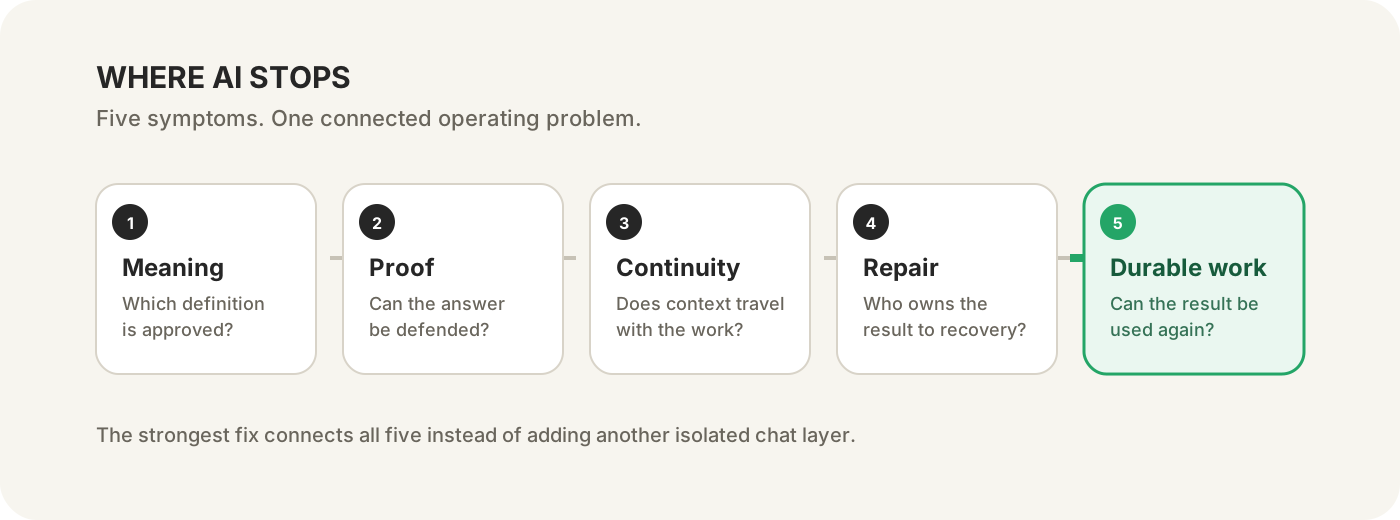
Continue the five-part series
- Part 1: Why AI keeps using the wrong business definition.
- Part 2: How to verify an AI-generated data answer.
- Part 3: Why more MCP servers do not finish the workflow.
- Part 4: Why AI can diagnose a broken dashboard but not repair it.
- Part 5: How to turn AI analysis into a reusable dashboard or workflow.
Or use the five-situation guide to find the stop closest to your team.