Why I Built Simple Survey: Keep the Questions, Lose the Form
I was tired of surveys that made people decode every question and finish in one sitting. Simple Survey keeps the required fields but lets people answer naturally.
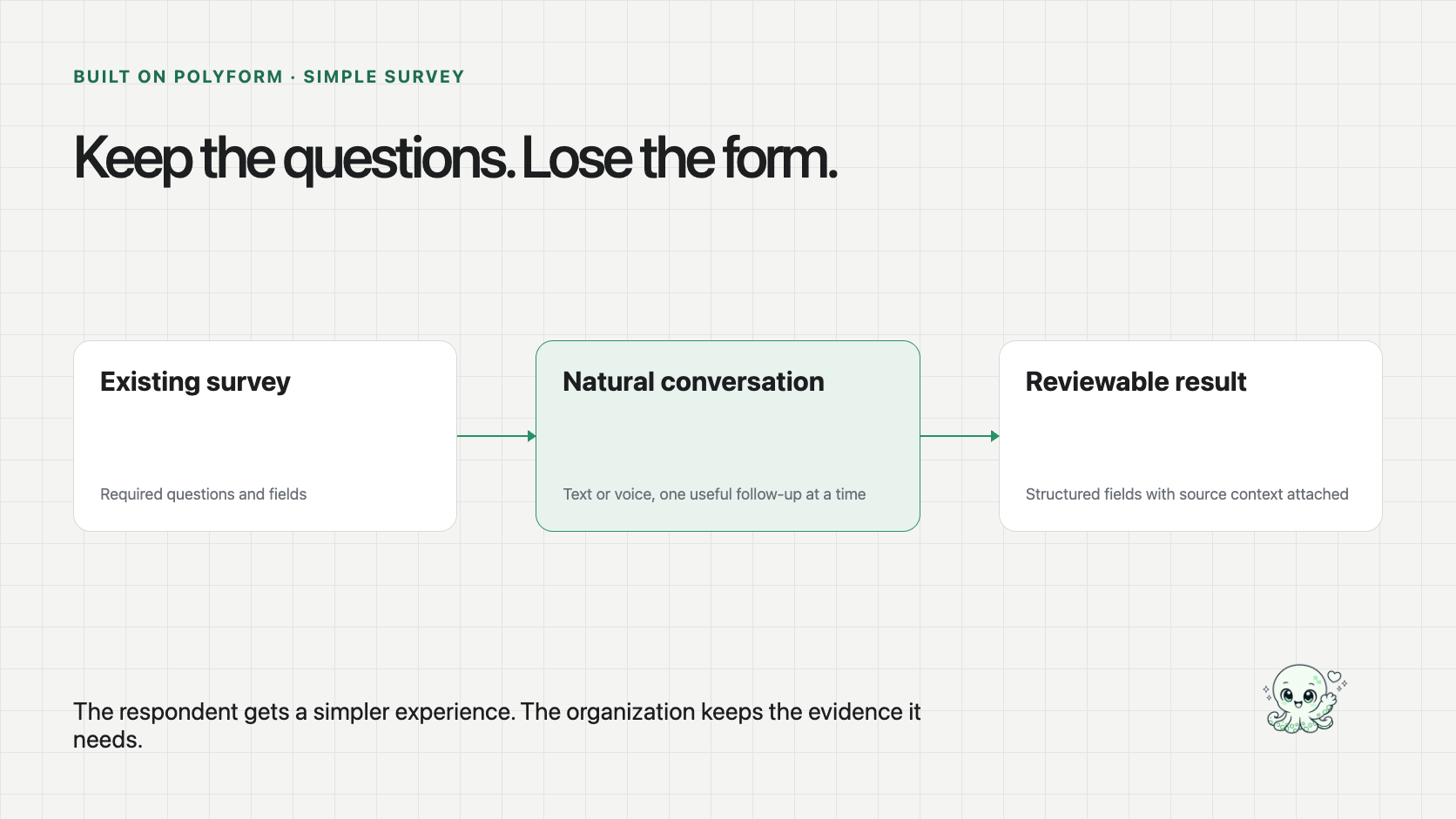
I hate filling out surveys. That was the first clue.
I do what most people do: I try to answer every question as quickly as possible and get out. I do not want to open another portal, sit in one place with a reliable internet connection, translate a real experience into a row of tiny boxes, and hope I understood each question the way the research team intended.
Then I watched the same frustration from the other side. We were working with teams that sent survey links through Mailchimp. People would start and not finish. Some answers clearly came from a different interpretation of the question. The form was not only collecting the response. It was quietly filtering who had the time, language, confidence, connection, and patience to complete it.
I do not have a publishable completion-rate benchmark from that work, and this is not a measured customer-result story. It is the product problem that made me want to build Simple Survey as a focused, human-reviewed pilot. You can see the current public product at simplesurvey.ai.
The problem behind the formA fixed survey makes the respondent do part of the research job
A conventional form asks the person to understand the interface, interpret every question, decide which part of their story belongs in which box, and finish the sequence the designer chose. A rich answer to the first question may already answer three later questions, but the form cannot notice. It asks them anyway.
That burden gets worse when the person would rather speak than type, needs to answer in another language, loses their connection, or cannot finish in one sitting. The research team may still need a strict set of fields. The person should not have to carry the strictness of the data model on their shoulders.
The form puts the structure on the person
- Interpret every question before answering
- Fit the experience into predetermined boxes
- Repeat information the team could have inferred
- Finish on the interface’s schedule
The conversation keeps the structure underneath
- Answer naturally by text or voice
- Map one response to every field it covers
- Ask only for information still missing
- Keep the source conversation for review
The survey can remain rigorous without making the respondent experience feel rigid.
The hidden job is data, coordination, and workflow
The visible product sounds simple: send a text, leave a voice note, answer a follow-up. Underneath, three different kinds of work have to stay connected.
Data work keeps the existing questions, required fields, translations, source messages, transcripts, and structured output related to one another. Coordination work remembers what this person already answered, what remains missing, what may be sensitive, and where a reviewer must make the call. Workflow work handles invitations, replies, reminders, processing, review, and delivery into the agreed system.
If those pieces live in separate tools, the “simple conversation” becomes a fragile integration project. A message can arrive without the right survey context. A transcript can be separated from the structured row. A reminder can be sent after the person already answered. An uncertain interpretation can become an invisible field value.
The power of Polyform was building the product in a couple of days
Once the problem was clear, we built the first working version of Simple Survey in a couple of days. That is a product built on Polyform: not a concept slide, but a bounded path that accepts an answer, remembers state, maps it into the survey, and returns something a person can review.
That couple-of-days timeline describes this build. It is not a promise for every product. The speed came from not having to assemble data, coordination, workflow, AI, review, and destinations from scratch. Polyform already connected them. We could spend the time deciding the product instead of rebuilding the platform underneath it.
The organization begins with the survey it already has: the goal, questions, required fields, consented audience, approved languages and channels, reminder rules, retention policy, and review boundary. The conversation can map each response to what it already answers. When required information is missing, it asks one useful follow-up. When interpretation is sensitive or uncertain, the result stays available for a person to review.
The customer’s warehouse can remain the business-data system of record. Polyform connects the processing and operating state needed for the experience without requiring the organization to abandon the other systems that still work. The resulting fields can support analysis, reporting, and downstream workflows while the source conversation remains attached for traceability.
Keep the questions, required fields, consent, and approved context.
Use the text, voice, language, and timing agreed for the pilot.
Connect the response to every required field it supports.
Continue when required information is still missing.
Keep the structured result inspectable before consequential use.
The conversation is adaptive. The evidence and required output do not disappear.
The human boundary is part of the design
Simple Survey is currently a product concept and pilot offer. The available channels, languages, reminders, output destinations, and review rules are agreed for each pilot. We are not claiming universal support, automatic legal compliance, measured completion improvement, or that software should make high-stakes interpretations alone.
That boundary is not a weakness. It is what lets the product begin with one consequential survey, one consented audience, and one reviewable result. The team can compare the structured output with the source conversation, correct the rules, and decide whether the experience deserves to expand.
A small interface can reveal what Polyform is for
The part I love is that the user may only see a text conversation. They do not need to see the data mapping, context, workflow, processing, review state, and output system underneath. They should simply get a better way to answer.
But the simple surface only works because the hard parts are connected. That is the larger idea behind Polyform workflows that turn context into controlled, observable action: the result should not stop at an AI interpretation. It should become usable data, remain tied to its evidence, and have a person who can recover the work when software should not guess.
Sometimes the best demonstration of a platform is not another platform screen. It is a focused product that removes work from the person who should never have had to do it.