Why I Built OpenFootage: Find the Story in the Footage
Before a Million left me sorting files, repeated takes, Shorts, and editor handoffs. OpenFootage turns that footage into a reviewable, versioned story.
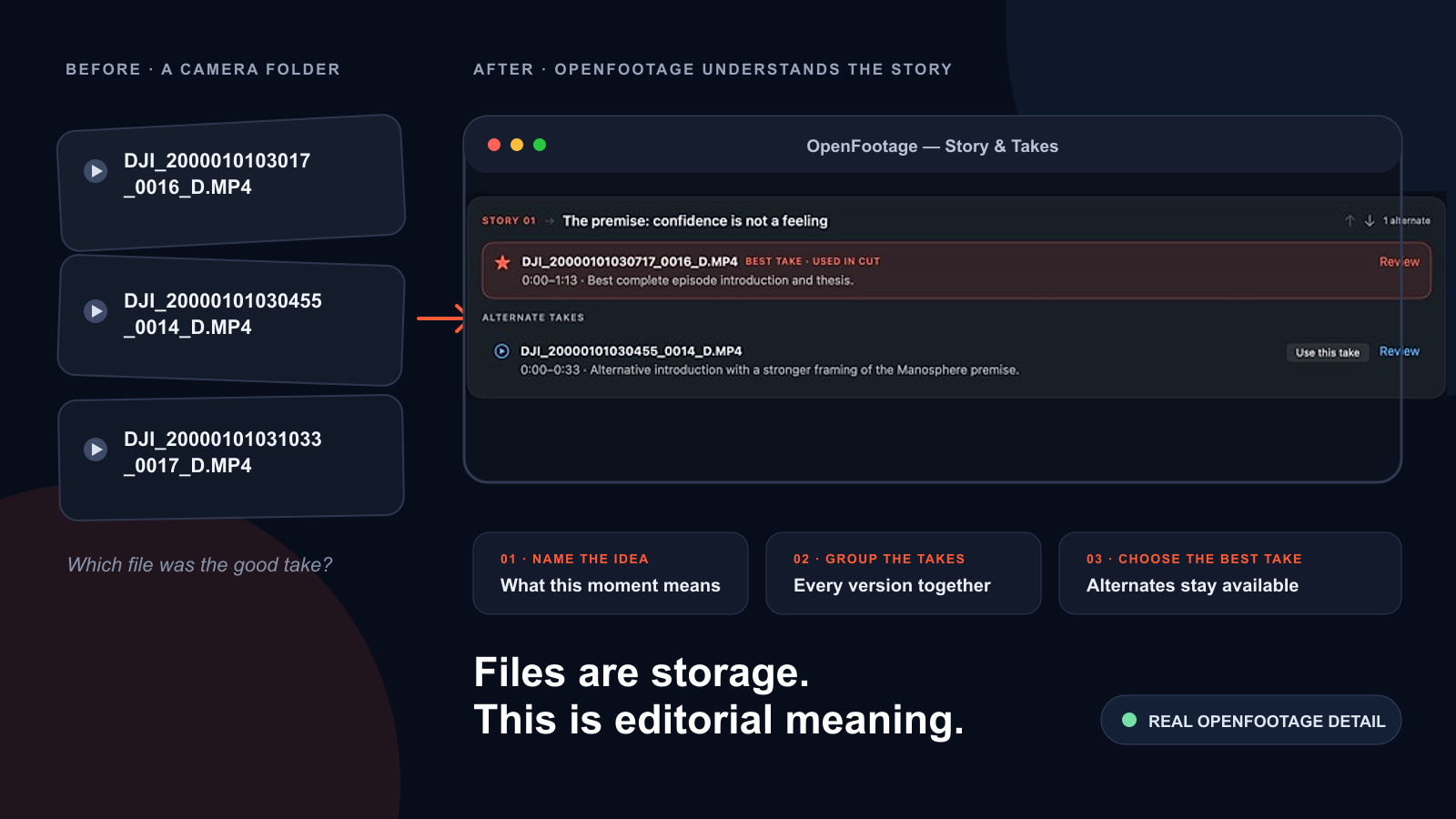
Before a Million taught me that cameras create files, not a story.
I started the podcast and YouTube series because I wanted to document what it looks like before the outcome is obvious—before the company works, before the story becomes clean, before the person knows exactly what they believe.
Then every recording created a second job. I would come back with a folder full of clips, multiple takes of the same idea, half-started sentences, strong moments buried in long files, and no durable map of what happened.
I could pay an editor, but that did not remove the hardest part. I still had to spend hours watching, remembering, labeling, explaining which take was best, deciding what belonged together, and finding the moments that could stand alone as Shorts. The footage was on disk. The meaning was still trapped in my head.
That frustration became OpenFootage: a local-first Mac workspace that lets me drop in the footage, understand what is there, find the strongest takes, build a cut, and keep every important decision reviewable.
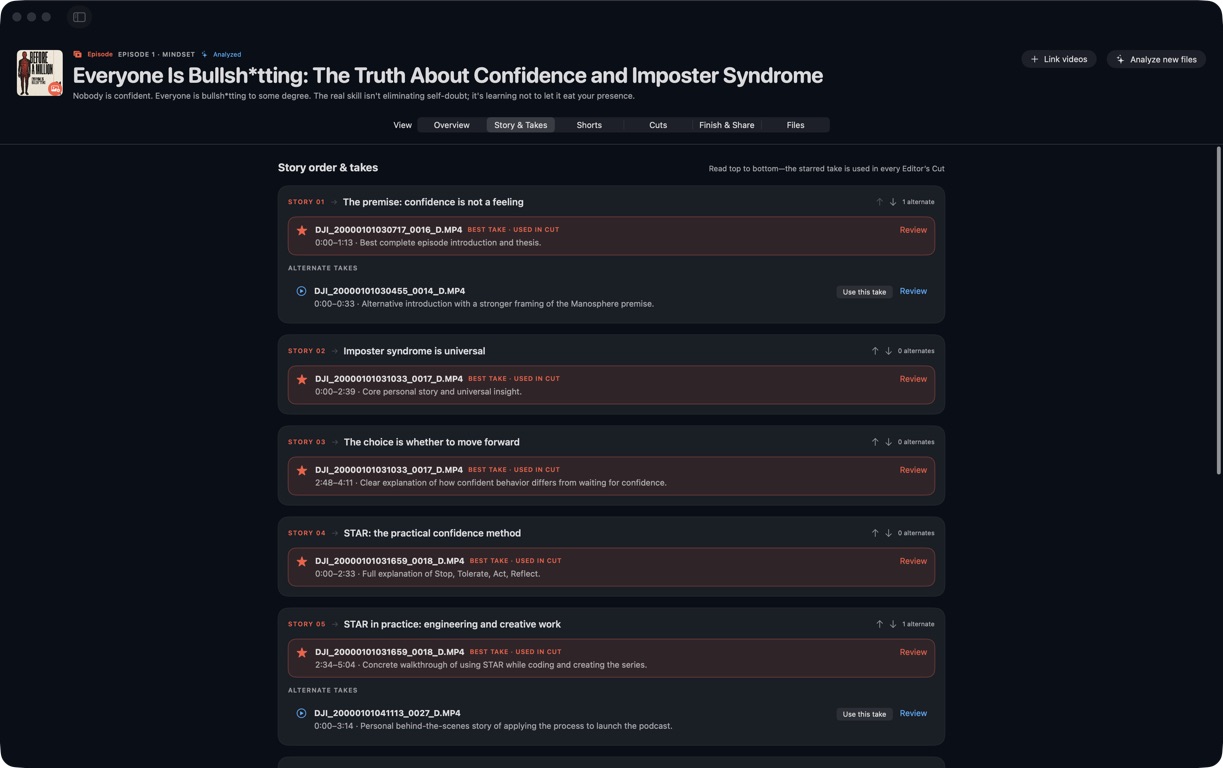
The timeline was not the first problem
Traditional editing tools are very good once you know what belongs on the timeline. My problem started earlier.
I needed to know what each file contained. Which clips were alternate takes of the same idea? Which take was the clearest? Where did I say something complete enough to become a Short? Which section was missing? Which transcript line supported the cut an AI or editor was proposing?
Without that layer, the project depended on memory and repeated viewing. Handing it to someone else meant translating the same invisible map again. Coming back a week later meant rebuilding the map for myself.
Inside my head
- Which filename contains the strong take
- What I meant across several attempts
- Which moment could become a Short
- Why one edit replaced another
Inside the project
- Searchable transcripts linked to source files
- Related takes grouped around the same idea
- Candidate moments with exact boundaries
- Versioned cuts a person can compare and review
The editor still makes creative decisions. The project stops making everyone rediscover the raw material first.
OpenFootage starts by making the footage legible
I can add the videos from a shoot and let OpenFootage create transcripts, name the ideas, group repeated takes, and put the strongest candidate first. That gives me an honest map of the material before I ask for an edit.
From there, I can build an Editor’s Cut from the source moments or find sections that stand on their own as Shorts. The point is not that AI has objective taste. It does not. The point is that it can do the exhausting retrieval and assembly work while showing me the source it used.
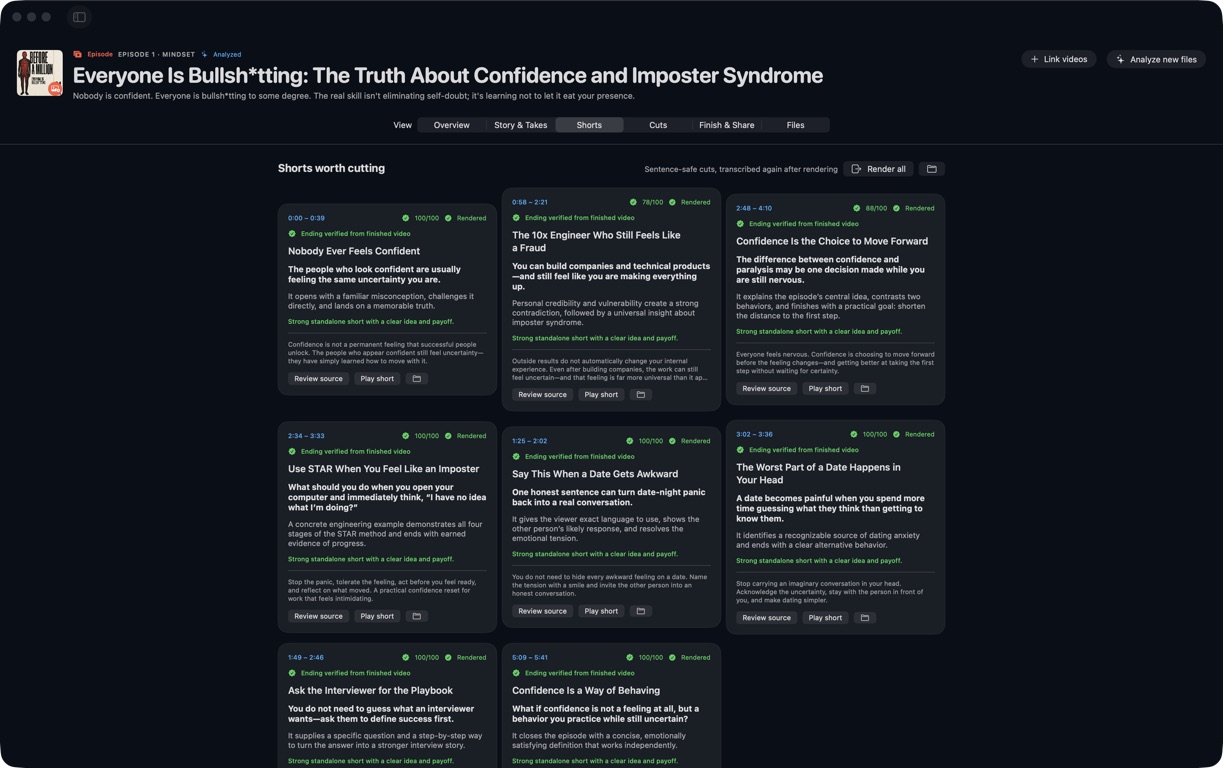
The original media stays untouched. Cuts are new, versioned artifacts. If I dislike a change, the prior version and the source footage still exist. Nothing publishes just because the software found a plausible sequence.
The local MCP server made ChatGPT part of the editing room
I did not want every useful request to become another button in the app. Sometimes I know the outcome I want and would rather say it plainly: use the second take, tighten this section, find the part where I explain the real problem, make a Short from that moment.
OpenFootage runs a local MCP server so ChatGPT can work with the project through explicit tools. A request can be matched to the exact transcript and source range, turned into a proposed cut, and returned as a new version for review.
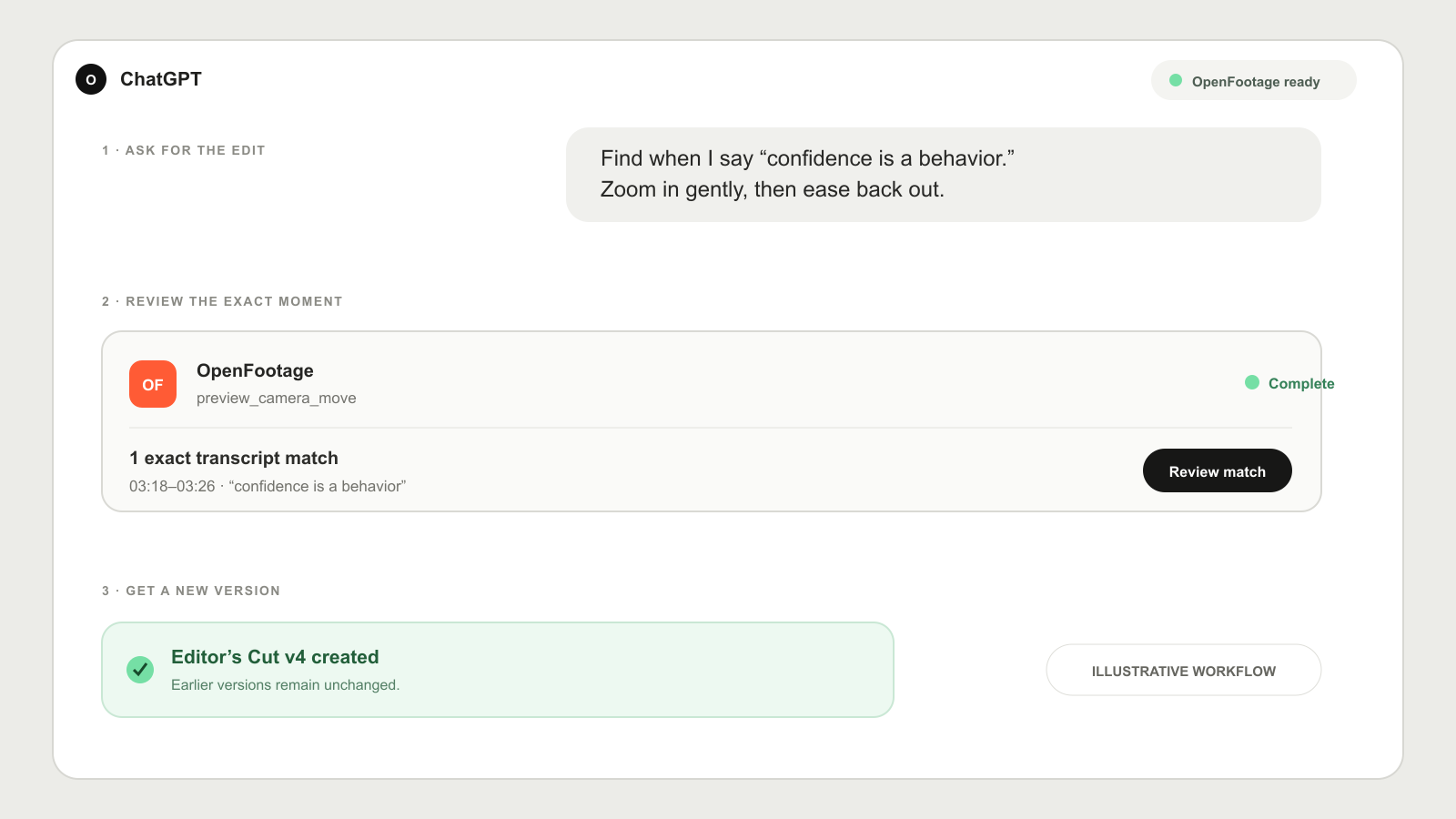
That makes the app feel less like a collection of AI features and more like a workspace I can direct. ChatGPT can help operate it, but OpenFootage remains the place where the footage, transcript, cuts, and decisions stay grounded.
Giving it to other people exposed the API-key problem again
Once OpenFootage made my own process better, I started giving it to more people. The same product gap I had found with JesSee appeared again.
The application was open source and the media workflow was useful, but setup still assumed that a person understood model providers, API keys, billing, and failure states. That is acceptable as an advanced option. It is a terrible front door for someone who just wants to edit a video.
So I made OpenFootage its own company inside Polyform too. A user can sign in with email, receive a short-lived authenticated session stored in the Mac Keychain, and use managed workflows for the AI work. People who want to bring an OpenAI or Azure key can still do that.
On my side, Polyform keeps the customer boundary, workflow behavior, and operating history understandable. I can see whether the problem belongs to the product, the workflow, or an external model without asking the user to diagnose the stack for me.
Add the camera files without changing or uploading the source library.
Turn filenames into searchable ideas linked to exact moments.
Compare repeated takes and identify complete moments for the story.
Use the app or ChatGPT to propose an edit with source evidence attached.
Inspect the cut, revise it, and publish only after explicit confirmation.
AI can move the edit forward without turning an irreversible creative decision into an automatic one.
The tool gave me more time for the part I actually care about
I did not build OpenFootage because I wanted to automate away editing. I built it because I wanted to spend less time recovering the meaning of footage I had already made.
The work is better when I can see the story, compare the real takes, direct a change in ordinary language, and know that the originals are still safe. The collaboration is better when an editor—or an AI—can enter a project with the same map I have instead of asking me to reconstruct it.
Building the managed experience on Polyform’s AI-first operating system completed the loop. OpenFootage began as a local tool for my own show. It became a product when other people could sign in, understand what it was doing, recover from failure, and use the AI without first becoming experts in API keys.
The camera still makes the files. OpenFootage helps me find the story.