Why I Built Lead Pack Around the Buyer Journey
Public research can describe an account. Lead Pack uses the first-party trail only your company can see to prepare the PowerPoint your sales team already uses.
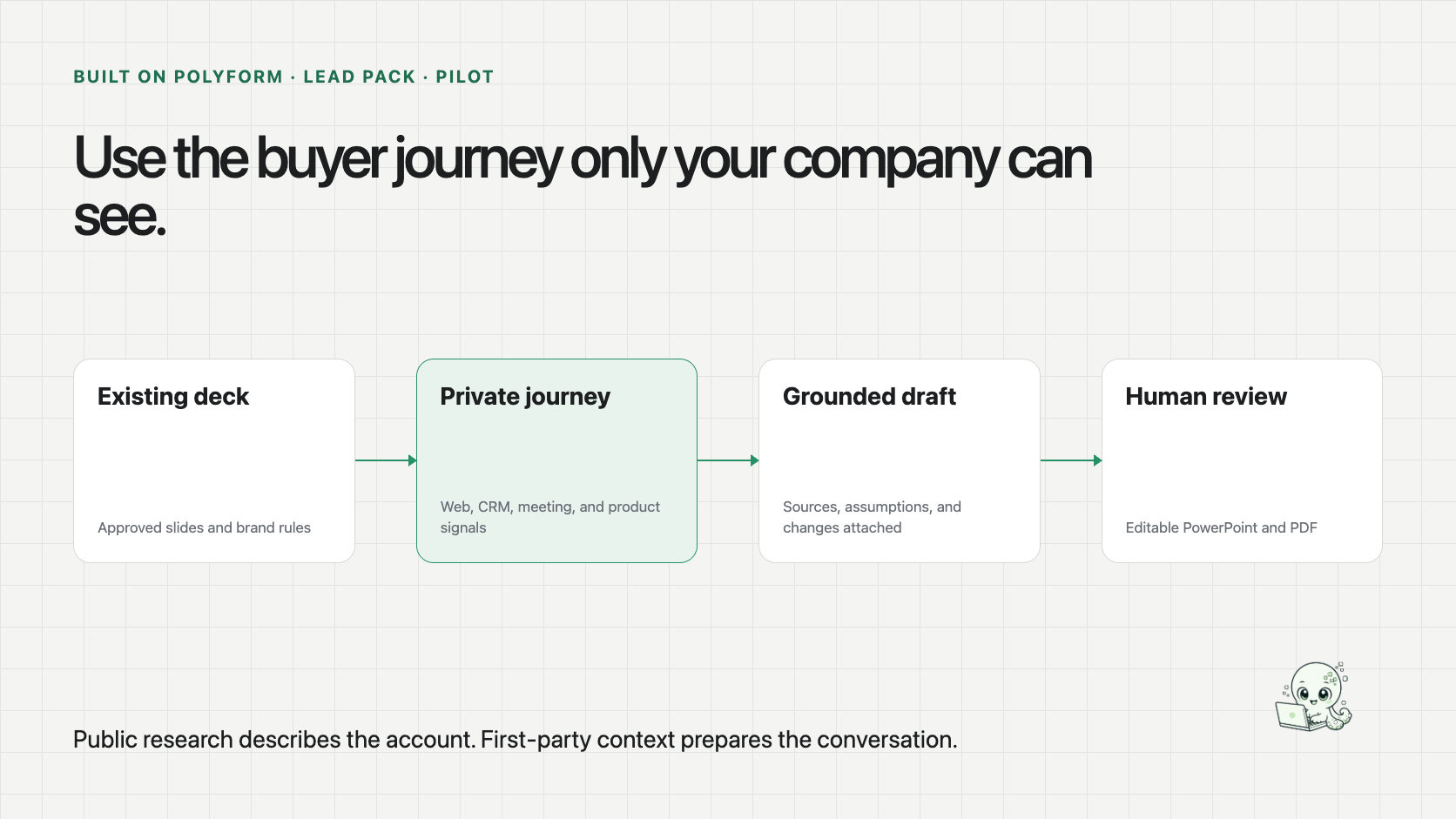
Anyone can research the account. The buyer journey is yours.
Before an important sales call, a seller can ask AI for the company overview, funding history, executive biographies, industry news, competitors, and likely priorities. That research can be useful. It is also broadly available to every seller trying to reach the same account.
The company already has a more valuable trail. It knows which page brought the buyer in, what they returned to, which emails or meetings happened, what they tried in the product, which questions were already answered, and where the conversation stopped.
That context is usually scattered across web analytics, the CRM, meeting notes, product or trial data, and the seller’s memory. Then the seller opens the same PowerPoint and prepares the call almost as if none of that journey existed.
We built Lead Pack as a review-first pilot to connect those two things: the private buyer journey the company can see and the deck the team already knows how to use. You can see the current public pilot at leadpack.ai.
The preparation problemA generated deck is not the advantage
There are plenty of ways to generate slides. Starting from a blank canvas can even be the right move for a new presentation. That was not the problem I wanted to solve.
A working sales team already has a presentation system: fixed slides, optional proof, approved language, brand rules, editable areas, and a sequence people understand. Replacing it with a fresh AI deck creates more review work and can throw away the material the company already trusts.
The advantage is not generation. It is choosing the right parts of the existing presentation, grounding them in the buyer’s first-party trail, making assumptions visible, and preparing better questions for the conversation ahead.
Research the account
- Company description and leadership
- Recent public announcements
- Industry and competitor context
- Information every seller can retrieve
Understand this buyer’s journey
- Pages and topics they returned to
- CRM and meeting history
- Approved product or trial activity
- Open questions only your team can see
Public research gives the account context. First-party evidence prepares the actual conversation.
The hidden job is data, coordination, and workflow
Data work brings approved GA4, Salesforce or HubSpot, meeting, and product or trial signals into a customer-owned BigQuery data store and resolves them around the right person and account.
Coordination work keeps that journey connected to the presentation rules: which slides are fixed, which proof is approved, what can change, which source supports a statement, what remains an assumption, and who owns the final decision.
Workflow work notices the upcoming conversation, assembles the relevant evidence and questions, prepares the editable PowerPoint and PDF, records a change summary, and puts the result in front of a person before anyone uses it.
If any one layer is missing, the product becomes less useful. A perfect CRM record does not update the deck. A slide generator does not know the private journey. A workflow that cannot show its sources turns preparation into confident guesswork.
Polyform turned the idea into a working pilot in a couple of days
Once we kept the existing deck as the constraint and defined the approved buyer journey, we built the first working Lead Pack pilot in a couple of days. We did not have to build a presentation editor, a separate orchestration layer, and a review system around an isolated model. We could connect the permitted signals to the artifact the team already used and keep the evidence, assumptions, and review state attached.
That couple-of-days timeline describes this pilot build. It is not a production-rollout promise or a claim that every source is instantly ready. That is the power of Polyform in this example: the maintained context, workflows, AI work, artifacts, and human review already belong to one operating environment, so the product work can begin with the buyer problem instead of the infrastructure underneath it.
The pilot begins with the existing PowerPoint and its rules. It connects the approved first-party sources for the scope. Before the call, it prepares an editable PowerPoint and PDF with relevant evidence, questions, sources, assumptions, and a summary of what changed. A person reviews the pack before it enters the conversation.
That last sentence matters. Lead Pack does not send a presentation to the prospect. It prepares a reviewable draft for the team. The goal is to improve the decision surface, not to automate judgment out of the sales process.
Preserve fixed slides, approved proof, editable areas, and brand rules.
Use approved web, CRM, meeting, and product or trial activity.
Carry the relevant trail into one preparation context.
Select material, questions, sources, assumptions, and changes.
Return an editable PowerPoint and PDF for approval.
The buyer journey changes the preparation. The seller keeps ownership of the conversation.
The pilot boundary keeps the story honest
Lead Pack is currently a pilot concept. Its examples describe the intended experience; they do not represent a live customer deployment. We are not claiming improved win rates, measured time savings, universal connector support, automatic prospect delivery, or production-scale reliability.
The smallest useful starting point is one existing PowerPoint, one approved data foundation, one review boundary, and one type of sales conversation. That scope is large enough to test whether private journey context changes the usefulness of the preparation and small enough for a person to inspect every source, assumption, and edit.
AI becomes more useful when it respects what already works
I did not want to build another generic AI presentation tool. I wanted to show what happens when we preserve the artifact people trust and connect it to the context their company already owns.
That is a recurring theme in Polyform’s warehouse-native data foundation. Useful systems can remain. The hard job is to connect their meaning, rules, evidence, and work into a result someone can actually use—and to keep the person who owns the decision visible at the end.
The deck is familiar. The journey underneath it is the advantage.